What kind of cleasning practice do you follow?

Poor leadership & dithering are reasons for JFLAG & Jamaica AIDS Support’s homelessness

Monday, July 23, 2012

Anti Gay Heckler gets a surprise ...........

0 comments
As we continue to track as best as possible and document real life issues here on the rock where same gender loving men in particular go through in navigating LGBTQ life amidst homonegativity and intolerance and with those who have no choice but to stay here for now here comes a story of some resiliance that had me saying yessssss! and with the recent brou ha ha over gay lies, (non)homophobic murders and other murders resting on our minds it is good to know not all of us are prepared to put up with foolishness especially when it all could have been avoided and everyone simply move on minding their own business, socially speaking that is.


A twenty three year old part time delivery man and an old LGBT party supporter found himself the brunt of anti homosexual sentiments in his community where he resided for the past seven years undisturbed, as we spoke over beers he related his encounter with a male new comer to his housing scheme and while it was not lost to him that he is the subject of many a dinner, porch,corner shop, barber chair and street corner conversation about his sexuality behind his back as in his own words "dem a try pree mi but caan guess" (they are trying to figure me out but cannot guess exactly) as he chuckled almost post triumphantly to his success after his encounter. The man who for this post I will call "Berry" is not the average or typical same gender lover as is profiled by other Jamaicans where the gage of effeminacy and stereotypical over bleached skin is used to profile percieved battyman as it were although Berry's is "rubbing" as we say in local parlance (or bleaching/skin lightening) which is also now accepted as a sign of thuggery in many inner city communities due to certain dancehall figures such as Vybz Kartel but was once used to pin point hypermasculine homosexuals or bisexuals for that matter in years gone by.


As Berry walked passed a popular community shop or house shop (where residents sell items to eek out a living) he over heard a conversation with male voices using the words battyman which was audible to him, he proceeded on his way but soon realised a few feet away from the shop that he was the intended subject of the description and the aforementioned newcomer to the commnunity began singing the infamous Buju Banton ode "Boom Bye Bye inna battyboi head" which unfortunately still available on many platforms online as evidenced below on Youtube despite the songs recommendation of finality for male Jamaican homosexuals or such persons percieved to be so inclined.


The newcomer proceeded to walk behind Berry as he continued his merry way and was egged on by the other men in the shop as this was audible to Berry as he said he heard them chuckling and saying "gwaan nuh" (go on quickly), Berry had proceeded to answer a call that came in on his cellphone and he responded via his headset, the newcomer raised the pitch of his voice as if to interrupt Berry's convo and Berry said he responded by turning sharply and in a stern voice asked what he was about (of course in our colourful patois) but the newcomer expected the diminutive Berry to either walk faster of flee from his Boom Bye Bye intimidation, as to the response from the onlookers Berry said most were silent but some other whispers in low tones that they suspected he was and that "him just a man it up" (he was being masculine or probably suggesting he plays the masculine role). 

The newcomer backed off reluctantly according to Berry as he would offer unfinished threatening statements as their distances grow wider, Berry who by this time had ended the phone call just walked away proudly he said as he did not fear the man and his supposed cronies what was surprising to Berry however he said was so called friends or brethrens who he plays football with and socialize otherwise were in on the minor incident.

He ended our conversation by suggesting that he had to watch his own head and he is not taking any chances as he does not know now who to trust now following this episode despite being circumspect and discreet in his actions while residing in the area for so many years, he also said it was the first time he has ever been openly heckled and pinpointed by others in the housing scheme. He said he does not even connect with other persons whom he suspects or knows as gays in the area just as a precaution nor does he take in any strange faces to his home for hookups or socializing, yet despite all that he was targeted.

What is instructive in all this to me is how persons take time to profile persons and their perceptions of same gender loving people, I too have come in for some sort of heckling some years ago on my very avenue where I live but persons know I am a no nonsense individual but one has to still be vigilant, like Berry's case it is always the newcomers to the area who seem to feel their strength as it were in openly voicing their anti gay positions and expecting one to cower in their taunts and heckles. Now the same individual who heckled me some time ago now passes me without exchanging a word. At that time I had ignored the taunt and went my way.

Sometimes some issues require direct responses while others require a face on reaction, one has to just decide I guess where one is comfortable with in their own answer to homo-negativity.

Peace and tolerance

H

Friday, July 20, 2012

World Health Organization issues first guidance on use of antiretrovirals by HIV-negative people at high risk to prevent infection (Pre-exposure prophylaxis (PrEP)

0 comments


20 JULY 2012 | GENEVA / WASHINGTON DC - WHO has issued its first guidance to countries that are considering offering HIV medications, known as antiretrovirals (ARVs), to protect people who do not have the virus but who are at high risk of HIV infection.

Pre-exposure prophylaxis (PrEP)

The guidance is based on clinical trials indicating that a daily dose of oral antiretroviral medication, known as pre-exposure prophylaxis (PrEP), taken by HIV-negative people to reduce the risk of infection, is both safe for people to use and effective in preventing HIV. The iPrEX study shows that use of PrEP can reduce HIV infection by around 40% among men who have sex with men – and up to 73% among those who took the medicine regularly. The Partners PrEP study found 75% protection among serodiscordant couples (couples in which one person is HIV positive) in Kenya and Uganda.
The range of results in these studies highlight the potential benefits of PrEP, but also the importance of combining it with consistent use of condoms, as well as frequent HIV testing, counselling, and treatment of sexually transmitted infections.
They also emphasize the importance of taking medicines every day. Many people who are at high risk for HIV may not easily be able to incorporate the diligent treatment regimen required, so the next challenge is to ascertain how best to deliver PrEP to those who would benefit from it in ‘real life’ settings in order to achieve the necessary adherence and maximum public health gains.

PrEP projects in countries

To better understand how PrEP can best contribute to a combination HIV prevention programme, WHO is encouraging countries wishing to introduce PrEP to first establish small projects to help public health workers to better understand and realize its potential benefits. In these projects, ARVs would be given to people at high risk of HIV infection. These could include uninfected men or transgender women who have sex with men who have a high risk of being HIV-positive. The aim is to identify which groups will benefit most from PrEP, and ascertain the best ways to deliver the services to them.

WHO will evaluate the outcome of these projects, together with the evolving scientific evidence. The results will help determine the best way to integrate PrEP guidance in future consolidated WHO guidelines on the use of antiretrovirals for preventing and treating HIV infection, which are expected in the summer of 2013.

New guidance

Today’s new guidance recommends that the projects pay particular attention to:
·         ensuring that people seeking PrEP are, in fact, HIV-negative, to guard against the development of drug resistance;
·         encouraging people using PrEP to continue using condoms;
·         checking that people seeking PrEP do not have medical conditions which would make taking ARVs inappropriate (e.g. pre-existing kidney or bone disease);
·         monitoring for any adverse events;
·         helping people using PrEP to adhere to the drug regimen of taking daily medication;
·         ensuring that people using PrEP have easy access to an uninterrupted supply of their medicine at a convenient time and place;
·         regularly testing for HIV infection in people who are taking PrEP, and checking for any sign of drug resistance if infection is found;
·         ensuring continued access to HIV prevention services for those who stop taking PrEP;
·         gathering more information on the cost-benefits of PrEP to help countries make decisions about how best to allocate limited resources, especially where not all people who need HIV treatment have access to it.

The United States Food and Drug Administration this week approved the use of ARVs as part of a comprehensive HIV prevention strategy for the country that includes condom use and other safe practices as well as testing and counselling. The manufacturer of the approved pill estimates that the medicine will typically cost US$13 900 per person per year in the United States.

Notes to editors

The XIX International AIDS Conference is taking place in Washington DC, 22–27 July 2012. The theme of the conference is “Turning the Tide Together”. WHO is presenting proposals to accelerate the elimination of HIV transmission, linking the latest science with what can be done on the ground. This includes a discussion paper on strategic use of antiretrovirals; a global report on drug resistance; guidance on the prevention and treatment of HIV and sexually transmitted infections among sex workers; and guidance on the prevention of hepatitis (a common co-infection with HIV) among people who inject drugs.

For more information and to arrange interviews, contact:

Sarah Russell (Washington DC)
Mobile:  +41 79 598 6823
E-mail: russellsa@who.int
Tarik Jasarevic (Geneva)
Telephone:  +41 22 791 5099
Mobile:  +41 79 367 6214
E-mail: jasarevict@who.int
Glenn Thomas (Geneva)
Telephone:  +41 22 791 3983
Mobile:  +41 79 509 0677
E-mail: thomasg@who.int


Thursday, July 19, 2012

Culture & Contact in the Promotion & Reduction of Anti-Gay Prejudice:Evidence from Jamaica & Britain

0 comments
Dr. Keon West. He is a social psychologist from the University of Leeds in the U.K. He is also a gay rights activist while being the son of the popular anti-gay activist, Dr. Wayne West, in Jamaica linked to the Lawyers' Christian Fellowship and other coalition groups. He has produced a study done on anti-gay attitudes in Jamaica called "Culture and Contact in the Promotion and Reduction of Anti-Gay Prejudice: Evidence from Jamaica and Britain" which sought to find out how to reduce sexual prejudice (anti-gay attitudes) in Jamaicans.

Dr West is also Jamaica's 2005/5 Rhodes Scholar as well.


also available in the Journal of Homosexuality 

DOI: 10.1080/00918369.2011.614907


KEON WEST, DPhil
Institute of Psychological Sciences, University of Leeds, Leeds, UK 

MILES HEWSTONE, DPhil
Department of Experimental Psychology, University of Oxford, Oxford, UK 
Jamaica has been called “the most homophobic place on Earth” (Padgett, 2006, p. 1), and has been involved in numerous inter-national incidents with Britain, and other countries, concerning anti-gay prejudice. However, neither the severity of Jamaican anti-gay prejudice, nor any means of reducing this prejudice has ever been empirically investigated. Intergroup contact—social interaction with a person from another group—is one of the most successful and widely used social–psychological interventions to reduce prejudice and improve intergroup relations. In this article,we compared sexual prejudice in Jamaica to that in Britain and investigated the relationship between contact and sexual prejudice in both countries. Jamaican participants reported more negative attitudes toward gay men than did British participants, but contact was more strongly associated with reduced sexual prejudice for Jamaican participants than for British participants. Implications for reducing Jamaican sexual prejudice are discussed. 


KEYWORDS contact hypothesis, homophobia, homosexuality,intergroup contact, intergroup relations, Jamaica, sexual prejudice 


If dem bring it tu wi, ful dem up a kappa shatRa-ta-tat evri chi chi man dem havi get flat
. . .
Chi-chi man fi ded an dats a fak

Culture and Contact 

[If they approach us with it (homosexuality), pump them full of coppershots (bullets)Ra-ta-tat, every gay has to get flat (? Lie on the ground dodging bullets)
. . .Gay men should die and that’s a fact.]” (Farquaharson, 2005, pp. 109–110)“Aal bati-man fi ded”[All homosexuals must die]. (Chin, 1997, p. 128)

Despite several claims of strong Jamaican prejudice against gay men (e.g.,Farquaharson, 2005; “OUTRAGED!,” 2004; Pinnock, 2007; Schleifer, 2004),and numerous international incidents concerning Jamaican anti-gay sentiment (e.g., “Homophobic Silliness and a Failure of Leadership,” 2008;“Identity Politics and Homophobia,” 2008; “London Pressures Dancehall Stars,” 2004) no study to date has ever attempted to investigate the strength of Jamaican anti-gay attitude, assess any method of changing it,or understand its predictors. With no empirical research on the issue, it is unsurprising that attempts by international gay-rights lobbies to impose anti-homophobia restrictions on Jamaicans have met with limited or no success(“Gay Lobby Rebuked,” 2008). 


What models can social psychology offer that may allow us to measure, understand, and reduce Jamaican sexual prejudice? Over 50 years ago, Gordon Allport (1954) hypothesised that contact— social interaction—between members of opposing groups would reduce bias and improve intergroup relations provided it occurred under certain conditions (i.e., equal status, common goals, intergroup cooperation, and institutional support). In the half century that followed, a wealth of research has supported the contact hypothesis (e.g., Brown, Vivian, & Hewstone,1999; Hamberger & Hewstone, 1997; Harwood, Hewstone, Paolini, & Voci,2005; Paolini, Hewstone, Cairns, & Voci, 2004; Plant & Devine, 2003; Voci & Hewstone, 2003; see Brown & Hewstone, 2005, for a review). 


A recent meta-analysis of 515 studies on intergroup contact (Pettigrew &Tropp, 2006) confirmed the robust, highly significant negative relationship between contact and prejudice, and contact is now one of the most widely used interventions for the reduction of prejudice and the improvement of intergroup relations (Hewstone, Rubin & Willis, 2002; Oskamp & Jones,2000).This study investigates the relationship between contact and sexual prejudice in Jamaica, comparing it to the corresponding relationship in Britain.The reasons for comparing Jamaica and Britain include their understudied sexual prejudice and their shared history: Jamaica was a British colony until independence in 1962 and continues to share cultural tendencies with Britain (Lambert et al., 1989). Also, several of the international incidents surrounding Jamaican anti-gay prejudice have occurred between Jamaica and Britain. These include the relatively benign, such as the cancellations of performances by Jamaican artistes in England (“London Pressures Dancehall Stars,” 2004), as well as the more egregious, such as the murder of British.honorary consul, John Terry (Bird & Reid, 2009). We begin with a discussion of sexual prejudice, particularly in Jamaica and Britain, before discussing the effects of contact on sexual prejudice in general and our current research on contact and sexual prejudice in both countries.

SEXUAL PREJUDICE

Homophobia is currently the most common term used to indicate anti-homosexual prejudice (see Choi, Han, Paul, & Ayala, 2011; Diaz, 2001;Herek, 1984; Lehne, 1976; Morin & Garfinkle, 1978; Weinberg, 1972), but this term has long been criticized. Millham, San Miguel, and Kellog (1976)considered it “oversimplification” (p. 3) as it lumps together all the varied negative attitudes, beliefs and behaviors toward homosexuals. Herek(1986) also discouraged the use of the term “homophobia” because it overly individualizes and “psychologizes” (p. 553) the prejudice at hand. In place of the term homophobia, we use the term “sexual prejudice” (see Herek,1986, 2004), which describes the phenomenon as what it actually is —any action, or general mode of conduct, whether it occurs on an individual or a systematic level, that disadvantages non-heterosexuals (Herek, 1986).Sexual prejudice is a global problem, occurring in many forms, at different levels of severity, and in many different societies (Herek, 2000; Herek &Berrill, 1992; Herek & Gonzalez-Rivera, 2006; McLelland, 2000; Polimeni,Hardie, & Buzwell, 2000; Rivers & Cowie, 2006; Subir, 2007; T. Williams &Maher, 2009). At its most severe, it can result in violent hate crimes, sexual attack, robbery, or vandalism (Herek, Gillis, & Cogan, 1999), and even murder (Willis, 2004). Other, less explicit forms of prejudice, such as avoidance,ostracism, disgust, disapproval (Herek, 2004), forced silence (Moran, 2011),and the withholding of legal rights (Araiza, 2010), also continue to have severe and enduring physical and psychological consequences.Most research on prejudice against homosexuals has taken place in North America, where this prejudice has been declining for some decades(Altemeyer, 2002; Millham et al., 1976), and where the gay movement has produced tangible changes including the contemporary debate around the legality of gay marriage (Araiza, 2010; Goodhough, 2009) and the repeal of the Don’t Ask Don’t Tell policy (Moran, 2011). However, in places where gays are more openly scorned and severely mistreated, such as Iraq(T. Williams & Maher, 2009) or St. Martin (Padgett, 2006), there has been little or no research. Such places are left to improve their situation without the guidance of any empirical research, or dependent on empirical research conducted by and in other countries, not knowing which, if any, findings are cross-culturally applicable. In this article, we take the first step toward filling these gaps in the research by investigating sexual prejudice in one country recently called “the most homophobic place on Earth” (Padgett, 2006, p. 1).


CONTACT AND SEXUAL PREJUDICE IN JAMAICA AND THE U.K

.

Contact has been shown to reduce prejudice in general and prejudice against gay men in particular. Furthermore, this effect was stronger on prejudice against people of different sexual orientations (r = −.271) than on prejudice against any other outgroup (e.g.,r (physically disabled)= −.243,r (race)=−.214, r (mentally ill)=−.184) 

However, of the research investi-gating the effect of contact on anti-gay prejudice, little has been conducted in the U.K. and none has been conducted in Jamaica. In Pettigrew andTropp’s (2006) meta-analysis of all available contact research to date, most studies (71%) were conducted in North America; of the studies specifically investigating the effect of contact on sexual prejudice, 23 of 25 were con-ducted in the United States, one was conducted in Canada, and one in New Zealand.


The Robert Carr Doctrine released ..............

0 comments
The following was released on July 17th by the MSM Global Forum and is deemed a set of Principles for Doctrine a Meaningful Response to HIV Among the World’s Key Affected Populations but after reading the document in its entirety I found nothing specifically on LGBT homelessness overall or hints to any related pyscho social support to enact behaviour change and or help them through self efficacious activities to arrive at an emancipated state, why are LGBT homeless populations not being given any serious attention and focus by LGBT advocacy structures in the Caribbean is puzzling to me given the rises in numbers and fallouts over time.

Bearing in mind Dr Carr was once among other things Executive Director for Jamaica AIDS Support for Life, Chairman of JFLAG's Management Committee I would have thought some more thought from Jamaican perspective given our current realities would have been brought to bear.

Many homeless LGBT persons especially MSM locally resort to commercial sex work to survive and in so doing engage in risky and dangerous behaviours mostly in outdoor settings which lead to literal errors in negotiating condom use or closing a deal in order to make a buck literally speaking, what about those realities? Apparently the MSM Global Forum does not see homelessness as a priority now or have it included specifically in the cadre of HIV prevention messages and programming and is missing from this doctrine so named after Dr. Robert Carr as it were.


a section of the document seems to cover it remotely where it says:

"The end of the HIV epidemic lies with our capacity to develop targeted, tactical, and multi-tiered approaches. Interventions and services are needed at the biological, behavioral, interpersonal, familial, community, social, cultural, and legal levels. All
stakeholders, at multiple levels, must act comprehensively, concurrently, over a sustained period of time, and with respect to the HUMAN RIGHTS and DIGNITY of MSM, people who use drugs, sex workers, and transgender people, including those living with HIV. Although difficult, COALITION work is transformative, and holds the key to unlocking our collective potential to end the epidemic. Ultimately, our success depends on how well we can work together to respond to those most in need." 

But shouldn't displacement and homelessess be tied into the loop as well?

Have a read of the rest of the release and download the PDF for further review:

Marginalized Populations around the World Unite,
Call for Revised Approach to Global HIV Epidemic

Global networks of gay men, people who use drugs, sex workers, transgender people and people living with HIV put forth new strategy for more effective global AIDS response
July 17, 2012 (Washington, D.C.) – As HIV rates continue to climb among marginalized groups around the world, the major global networks of gay men, people who use drugs, sex workers, transgender people and people living with HIV have put forth a series of joint recommendations for a more effective global AIDS response. The recommendations were released earlier today in a set of principles entitled “The Robert Carr Doctrine,” named for the well-respected international AIDS activist who passed away one year ago.

“For the past thirty years, the global AIDS response has been characterized by ‘one size fits all’ programs that fail to address the drivers of the epidemic among the world’s most at risk populations,” said Dr. George Ayala, Executive Director of the Global Forum on MSM & HIV (MSMGF). “Stigma, discrimination, violence, and criminalization block access to HIV services for gay men, sex workers, people who use drugs, and transgender people.”

“With HIV rates skyrocketing among these groups around the world, we can no longer ignore science for politically expedient solutions,” said Dr. Kevin Moody, Chief Executive Officer of the Global Network of People Living with HIV (GNP+). “It is time for targeted, tailored, multi-sector community-led responses.”

The Carr Doctrine calls on all stakeholders to re-think the global response to AIDS, urging actors to recognize that HIV is not just a public health issue, but rather a symptom of underlying societal inequities and injustices. Accordingly, the Doctrine calls for a coordinated strategy at behavioral, social, structural, and legal levels.

“In our collective experience across each of these populations, we have found that a coordinated response is key to addressing HIV effectively,” said Ruth Morgan Thomas, Global Coordinator of the Global Network of Sex Work Projects (NSWP). “A country cannot claim to prioritize sex workers in its national AIDS strategy when that country’s police are actively arresting and brutalizing sex workers. What good is it to supply people with condoms when the police use condoms as evidence of sex work, arresting the people who carry them?”

The Carr Doctrine represents the first time that the global networks of key affected populations have come together to forge a shared strategy. Each network is largely made up of community activists and organizations, all working to address the epidemic among their respective constituencies.

“The history of HIV is largely a story of people standing up to protect their communities when no one else will,” said Dr. Eliot Albers, Executive Director of the International Network of People Who Use Drugs (INPUD). “While each key affected population is unique in its own right, we all have this in common. After thirty years of AIDS, HIV services remain out of reach for the vast majority of our constituents. It is time we stood together to demand the response our communities deserve.”

The launch of the Carr Doctrine was timed to coincide with the start of the International AIDS Conference, taking place the week of July 23rd in Washington, D.C. The organizers of the conference have hailed this year as a potential turning point in the epidemic, citing the development of new technologies like pre-exposure prophylaxis and treatment as prevention.

“Scientific advances like pre-exposure prophylaxis are exciting of course,” said Mauro Cabral, Co-Director of Global Action for Trans* Equality (GATE). “But they will fail to make a dent in the epidemic among key affected populations if legal, social, and political barriers continue to impede access to services. In order to create lasting change, science must be balanced with rights-based structural intervention – they are two sides of one coin.”

The HIV Epidemic among Most-At-Risk Populations

A Johns Hopkins-led review of HIV prevalence in 38 low- and middle-income countries found that gay men and other men who have sex with men (MSM) are more than 19 times more likely to be infected with HIV than the general population, yet the Global HIV Prevention Working Group has estimated that only 9 percent of MSM around the world have access to HIV prevention services.

According to the journal Health and Human Rights, only an estimated 22% of female sex workers in Sub-Saharan Africa have access to HIV prevention services, despite infection rates as high as 54%, 68%, and 73% in Burkina Faso, Zambia, and Ethiopia, respectively.

According to a systematic review published in The Lancet, HIV prevalence among people who inject drugs (IDU) was 20-40% in five countries and over 40% in nine. Yet worldwide, only an estimated two clean needles were distributed per IDU per month, eight IDU per 100 received opiate substitution therapy, and four HIV-positive IDU per 100 received antiretroviral therapy.

According to the World Health Organization, transgender populations around the world face HIV prevalence rates of between 8% and 68%. Very little data exists on access to HIV services among transgender populations.The full text of the Robert Carr Doctrine can be found online at http://www.msmgf.org/files/msmgf//documents/RobertCarrDoctrine.pdf.


here is an excerpt:

RE-STRUCTURE the response
HIV is not just a public health issue. The current response to the epidemic is underpinned by the faulty assumption that HIV is solely a public health issue. Efforts to address the epidemic are therefore centered on a narrow range of actors and strategies. In reality, the epidemic is a symptom of underlying societal inequities and injustices. A National AIDS Council that prioritizes key affected populations is severely compromised when the rest of that country’s government continues to arrest, harass, and violate the rights of MSM, people who use drugs, sex workers, and transgender people, including those living with HIV. Similarly, scientific advances in HIV prevention and treatment, while welcomed and strongly encouraged, are wasted when communities shouldering a disproportionate HIV disease burden are blatantly denied access to services or cannot access them safely. Bilateral and multilateral funding strategies that fail to prioritize investment toward 
hardest-hit populations, civil society advocacy, and community development will inevitably fall short of achieving an “AIDS-Free Generation.” Structural factors drive the HIV epidemic, so our solutions must address those factors as well. Small-scale interventions targeted at the individual level are important, but they are not enough.  
You decide, interesting that we have to get such a comprehensive timeline from FAREEEEENNNN!!!!! (foreign territory) instead of here towards the LGBT community via some general forumatic activity.

click the "Homeless MSM in Jamaica" tab immediately below for previous entries on the subject

Wednesday, July 18, 2012

The Caribbean Vanity Fair (LGBTQIQ2S Grammy Awards) has a new date: August 18, 2012

0 comments
Just Fine Promotions has done it again; the Caribbean Vanity Fair in all its marvelous glory has postponed its date for a BIGGER, BETTER, more CLASSIC Experience...the new date is SATURDAY AUGUST 18TH, presold tickets are available. 


Singles $2,500 couples $4,000 so avoid the rush and get yours early from the following locations & individuals

All Dolled Up
Rupunzel & Chic Fashionista
Bling Bling
Traffic Mode
Fetish Secretz
D Trends
Spencer Just Fine
Latoya Thugz
Stacy J


The CVF Grammys 2011-2012.....August 18th 7:30 pm at a venue TBA comes alive with the just fine dancers n our very own star queens Diva Waugh, Macey Antibellum Grey, Kookie Balenciaga, Monica Nage Trendsett, Ms Mercedes Vuttion straight from her tour....special guest performer Ms Alicia Dupree from the Bahamas. It's gonna be epically fierce 


Born and Raised in the Bahamas she has been in the Entertainment Industry for 9 long years, where she now goes by the stage name Alicia Dupree, started out at the young age of 16 Alicia was introduced to the Gay scene where she met a guy dressed like a female and was instantly amazed by it, after a bit of curiosity she decided that she wanted to enter the pageants and the world of glitz and glam, throughout her entertainment career Alicia was able to capture few titles as Miss Drag Bahamas, Entertainer of the year Bahamas, Miss Styles Bahamas, and Miss Bitch Bahamas, and was also able to Capture a international Title as Miss South Beach Miami, her talents has also afforded her the opportunity to showcase her skills in shows in Jamaica, Atlanta, Miami and New York...

Alicia works as a Make up Artist, Part Time Model and Fashion Consultant in the Bahamas where she is able to express herself through creating beautiful garments, and believe in the quote that "a dress should be tight enough to show that you are a woman, but loose enough to prove that you are a lady"...


This year's Special awards will include:

The legendary award will go to Leroy Marshall, Legendary Club Owner and pioneer
The humanitarian award will be presented to Stacy "Sheeba"

Posthumous recognition in the form of a tribute done by a special guest to all our brothers and sisters who passed away over the many years.

The highlight of the evening will be the launch of the justfinepromotions Echo '2' Action Foundation - a platform created to cater to marginalize youths devoid of d fundamental human rights to family life.

The Echo '2' Action first scholarship awarded to an individual for training at a selected community college to be named at the awards show

A unforgettable performance show with d theme Hollywood Glitz N Glam meets JA 50

Special thanks to all our sponsors
Fetish Sectetz
J-Flag
Traffic mode
All Dolled Up
Chic Fashioniesta
Rupunzel
Salon Fierce
Bling Bling
Cake by Tashana
Party Fantasy
Occasional Chocolate n Catering Service Envelop Couture
Haaso Productions
Andres Enterprise
Club Heavens
*Tabs
Thebloomparty
Green Rewards

and Endorsed by: thepinkreport, Couture Elements, Alter Ego Entertainment and the Underlined Response team.

*Tabs 
is operated from a Youth Empowerment Project implemented through USAID & World Learning Support 

More to come on this event. 
... A Justfine Promotions event. 

Peace and tolerance

H


click the "Homeless MSM in Jamaica" tab immediately below for previous entries on the subject

Friday, July 13, 2012

Gays take aim at Betty Ann Blaine says Observer ......

0 comments
This of course is not the first blogger to have pointed out Miss Blaine's course of advocacy in berating the gay community's struggles and calls for rights, now has come a new blogger who is carrying on the agitation as done by this blog, Pensive Moods and others locally and overseas based LGBT writers, Miss Blaine and by extension the Observer are late in realising she has been and is being watched as to her utterances and posturings.


JAMAICA Observer columnist Betty Ann Blaine has come under fire from the lesbian, bi-sexual, gay and transsexual community for her column entitled 'The big gay lie', which appeared in Tuesday's edition of the paper.

A website, antigayfact.wordpress.com, has dubbed Blaine an anti-gay activist.


"Betty Ann Blaine happens to be one of the anti-gay activists that AGFC keeps a close eye on," a report on the website stated.

But Blaine was far from amused Tuesday and said that she considered the statement a veiled threat.

"This is of great concern to me. What does 'keep a close eye on' mean? I don't know if they have me on a hit list. Is someone stalking me? Does it mean I am under surveillance? This is amazing," Blaine told the Jamaica Observer.

In her column, Blaine made reference to a Sunday Observer article in which former Assistant Commissioner of Police Les Green attempted to debunk a claim by gay rights group Jamaica Forum for Lesbians All-Sexuals and Gays that gays who are the victims of murder are killed by homophobic Jamaicans. Green said his investigations have unearthed evidence that most of the killings he investigated were committed by other gay persons.

The website also took issue with Green's statements and alleged that the article, titled Gay claims not true, was part of this newspaper's 'anti-gay propaganda machinery'.

Tuesday, Blaine rubbished claims that she was an anti-gay activist and defended her right to free speech.

"All I have done is speak the truth. I love everybody. I don't care if they are gay or straight, but I don't support the lifestyle or behaviour," she said.

JFLAG has long advocated a repeal of the buggery legislation, which outlaws anal sex. Under the law, an offender can receive a maximum sentence of 10 years.

Blaine, however, said the law should remain in place until deviant sexual behaviour by adults toward minors is eliminated.

"We are not changing the buggery law. 


The number of children who are being buggered in Jamaica means we can't change the law until we can be assured that our children will be protected from sexual predators. This is the time to strengthen laws that refer to sexual behaviour because we know that children are being buggered in Jamaica and it is happening behind closed doors and in secret places," Blaine said.

She argued that most children who are vulnerable to sexual abuse are from underprivileged backgrounds.

"We cannot change the buggery law until we fix poverty. It is because a lot of children are so poor why they face sexual abuse, whether it is homosexual or heterosexual," she said.


also see: 

We lose out, Betty Ann (Observer Letter)


also see:


and


also see JFLAG's morning appearance on Television Jamaica's TVJ, morning program Smile Jamaica on July 13th where the ED spoke to the issue, see what you make of it:


video

more responses in letters from newspapers:
A Gay's Life is Not an easy road
The Big Gay Lie is a Fact (an alleged police officer wrote)


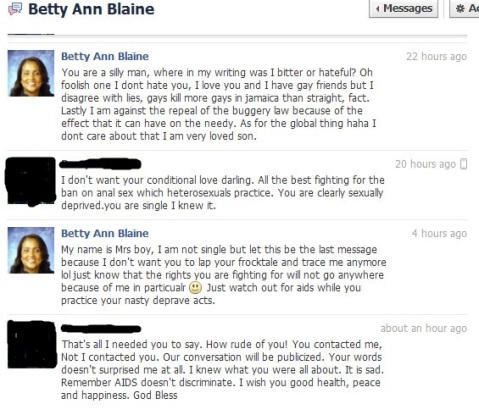
also is an interesting Facebook exchange on her profile with a LGBT community member reveals much disturbingly:

And she finds it offensive when the AGFC (antigayfactcheck) called her an anti-gay activist?

What does she mean by “Just know that the rights you are fighting for will not go anywhere because of me in particular“? Is that a threat to attack our free speech?
This is the woman that wants to be Prime Minister with her political party, New Nation Coalition? 

Is this how she will treat the fight against AIDS as the leader of our country? As something gays have because of their “nasty deprave [sic] acts“? 

To think of AIDS as something to laugh about?

Is this what her indulgence into the anti-gay agenda turned her into? What happened to the human rights and child rights activist we knew of?


more audio feedback on how persons feel about Jamaica being one of the most homophobic countries 

LinkWithin

Related Posts with Thumbnails

Cabinet delays buggery review, says it's not a priority & more ...........................

MORE PROBLEMATIC HOMELESS MSM ISSUES for JULY 2012

What to Do .....

When Arrested and taken to a Police Station you have the right to:

a. Make a phone call: to a lawyer or relative or anyone
b. Ask to see a lawyer immediately: if you don’t have the money ask for a Duty Council
c. A Duty Council is a lawyer provided by the state
d. Talk to a lawyer before you talk to the police
e. Tell your lawyer if anyone hits you and identify who did so by name and number
f. Give no explanations excuses or stories: you can make your defense later in court based on what you and your lawyer decided
g. Ask the sub officer in charge of the station to grant bail once you are charged with an offence
h. Ask to be taken before a justice of The Peace immediately if the sub officer refuses you bail
i. Demand to be brought before a Resident Magistrate and have your lawyer ask the judge for bail
j. Ask that any property taken from you be listed and sealed in your presence
Cases of Assault:An assault is an apprehension that someone is about to hit you

The following may apply:
1) Call 119 or go to the station or the police arrives depending on the severity of the injuries

2) The report must be about the incident as it happened, once the report is admitted as evidence it becomes the basis for the trial

3) Critical evidence must be gathered as to the injuries received which may include a Doctor’s report of the injuries.

4) The description must be clearly stated; describing injuries directly and identifying them clearly, show the doctor the injuries clearly upon the visit it must be able to stand up under cross examination in court.

5) Misguided evidence threatens the credibility of the witness during a trial; avoid the questioning of the witnesses credibility, the tribunal of fact must be able to rely on the witness’s word in presenting evidence

6) The court is guided by credible evidence on which it will make it’s finding of facts

7) Bolster the credibility of a case by a report from an independent disinterested party.

Taboo...Yardies Trailer

The concept of the documentary Taboo...Yardies is to explore the perception of Jamaica as an Island that is saturated with homophobia by providing Jamaicans who are pro, con and everywhere in between this highly controversial issue. These are the voices of those who dare to speak up and out on human rights.

Popular Posts

Atheism & Secularism may cloud the struggle for lgbt rights in Jamaica

recent discussions seem to cloud the thrust for advocacy in regards to decriminalization of buggery and privacy rights for same gender loving people

Information & Disclaimer

Not all views expressed are those of GJW

This blog contains pictures and images that may be disturbing. As we seek to highlight the plight of victims of homophobic violence here in Jamaica, the purpose of the pics is to show physical evidence of claims of said violence over the years and to bring a voice of the same victims to the world.

Many recover over time, at pains, as relocation and hiding are options in that process. Please view with care or use the Happenings section to select other posts of a different nature.


Not all persons depicted in photos are gay or lesbian and it is not intended to portray them as such, save and except for the relevance of the particular post under which they appear.

Please use the snapshot feature to preview by pointing the cursor at the item(s) of interest. Such item(s) have a small white dialogue box icon appearing to their top right hand side.

God Bless


Other Blogs I write to:
http://glbtqjamaica.blogspot.com/
Recent Homophobic Incidents CLICK HERE for related posts/labels from glbtqjamaica's blog & HERE for those I am aware of.

contact:
lgbtevent@gmail.com
glbtqjamaica@live.com

John Maxwell's House

Thanks for your Donations

Hello readers,
thank you for your donations via Paypal in helping to keep this blog going and related costs. Please continue to support me and my allies in this venure that has now become a full time activity. When I first started blogging in late 2007 it was just as a pass time to highlight GLBTQ issues in Jamaica under then JFLAG's blogspot page but now clearly there is a need for more forumatic activity which I want to continue to play my part.

Donations presently are only accepted via Paypal where buttons are placed at points on this and the GLBTQ's blog as well. If you wish to send donations otherwise please contact: glbtqjamaica@live.com


Activities & Plans: ongoing and future


  • To continue this venture towards website development with an E-zine focus

  • Work with other Non Governmental organizations old and new towards similar focus and objectives

  • To find common ground on issues affecting GLBTQ and straight friendly persons in Jamaica towards tolerance and harmony

  • Exposing homophobic activities and suggesting corrective solutions

  • To formalise GLBTQ Jamaica's activities in the long term

  • Continuing discussion on issues affecting GLBTQ people in Jamaica and elsewhere

  • Welcoming, examining and implemeting suggestions and ideas from you the viewing public

  • Present issues on HIV/AIDS related matters in a timely and accurate manner

  • Assist where possible victims of homophobic violence and abuse financially and otherwise

  • Track human rights issues in general with a view to support for ALL


Thanks again
Howie
lgbtevent@gmail.com
http://glbtqjamaica.blogspot.com/
http://glbtqjamaicalinkup.ning.com/


Peace